How to Start an Online Clothing Business From Home
Starting your own online clothing business in 2026 may turn out to be easier than you expect. You can begin small and only invest more as you see your first sales. Here’s what you can do
First, you don’t have to open a shop and buy stock to start selling. For more ideas, see our guide How to Start a Small Business from Home . You can work from the comfort of your home while you build a client base. What you need to do is figure out what clothes to sell and who you want to sell them to. It’s also good to find a reliable supplier and set realistic prices. The following guide will walk you through the process of launching a clothing business and selling your clothes online.
This ultimate guide to starting an online clothing business will walk you through finding a niche, finding products and suppliers, pricing your wares, and setting up your online storefront, and more.
Quick Answer
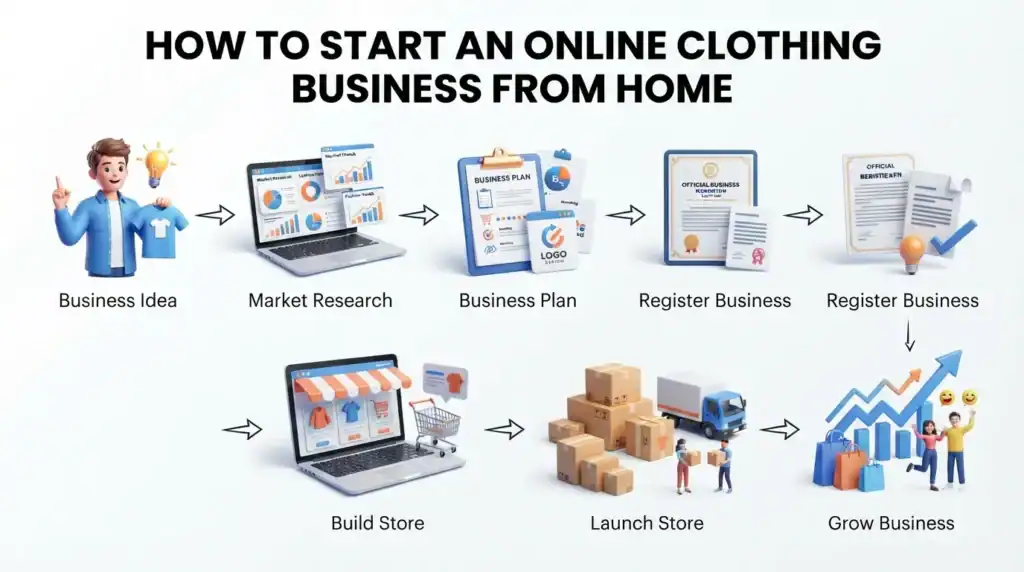
To start an online clothing business in 2026, a person will have to:
- Pick a clothing niche,
- Research the competition and demand,
- Choose a business model,
- Define the target audience,
- Find and vet suppliers,
- Calculate costs,
- Set prices,
- Build an online store,
- Organize logistics and returns,
- Launch the site with a marketing plan,
- Monitor sales, conversion rates, costs, and customer feedback,
- And scale the most popular products and marketing channels.
The point of this business is not to create a clothing empire but to build a small online store that would help test the market and find the most demanded products.
1. Choose a Profitable Clothing Niche
Possible clothing niches include:
- Streetwear
- Modest fashion
- Activewear
- Women’s clothing
- Men’s clothing
- Kids’ apparel
- Plus-size fashion
- Vintage clothing
- Custom T-shirts
- Sustainable apparel
- Workwear
- Occasion wear
If you’re exploring more business ideas for women at home, you can compare different options before choosing your niche. Avoid creating a general niche that is based on popularity rather than a specific client group. Choose a group with a particular need and want and provide them with a certain kind of goods.
Examples:
Women’s clothes
Affordable and elegant clothes for young working women.
Now, when you have a certain product and you’ve identified your customer group, it will be easier to choose what to present, set up prices, write descriptions, and even promote your business.
More: Free ai Business Ideas Generator
What to Research
Look at:
- Competitor products
- Competitor pricing
- Customer reviews
- Common complaints
- Fabric expectations
- Popular sizes
- Product gaps
- Search demand
- Social media engagement
- Delivery expectations
Customer complaints are often valuable.
If customers complain that clothes do not fit well, are made of cheap material, are too small in size, arrive late, or are too expensive, it can indicate what needs improvement.
An SBA recommendation to narrow your focus is to conduct market research to determine demand, consumer characteristics and preferences, market size, and competitiveness.
A narrow focus is often more effective than trying to appeal to everyone by offering diverse clothing sizes and cuts.
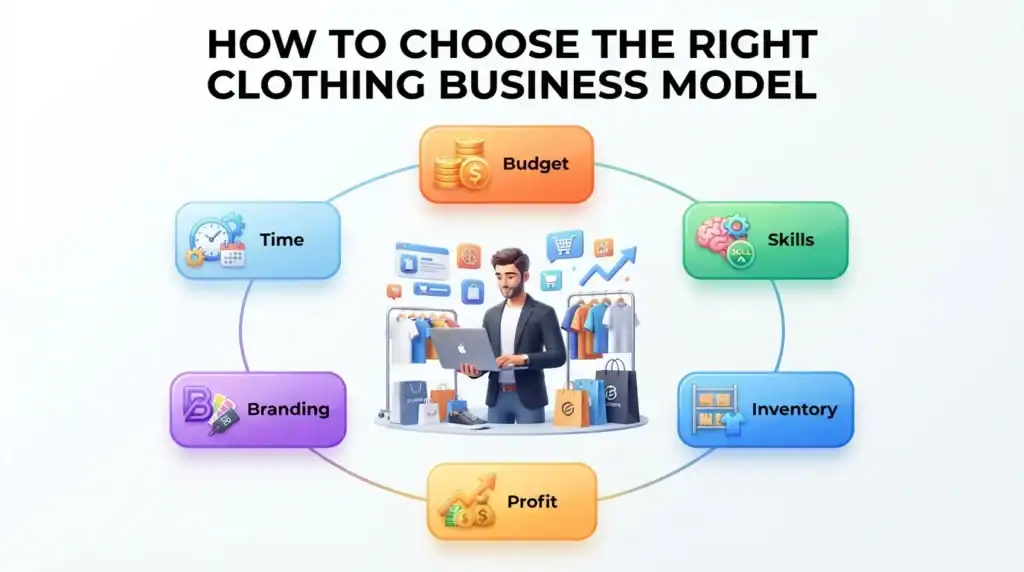
2. Choose the Right Clothing Business Model
You do not necessarily need to manufacture your own clothes. Beginners can also explore other online business ideas.
Your business model determines how much inventory you need, how much control you have, and how much money you may need upfront.
| Business Model | Upfront Cost | Inventory | Control | Best For |
| Print-on-demand | Low | No | Medium | Testing designs |
| Dropshipping | Low | No | Low–medium | Beginners |
| Wholesale | Medium | Yes | Medium | Reselling |
| Private label | Medium–high | Usually | High | Building a brand |
| Custom manufacturing | High | Yes | Very high | Original collections |
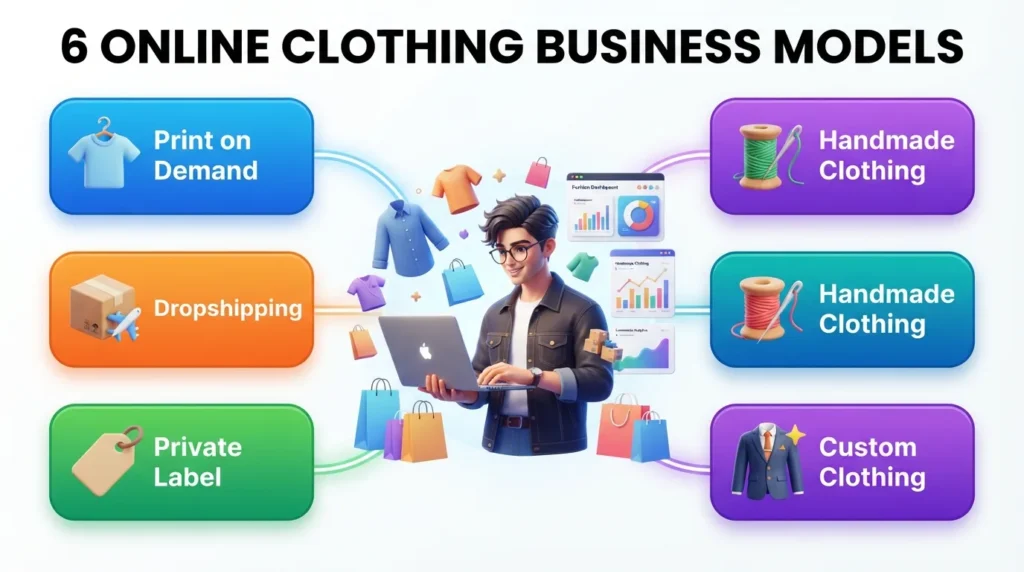
Print-on-demand
Products are made when customers order them.
It reduces the risk of holding inventory and allows you to test designs before scaling up production.
Dropshipping
Suppliers hold the stock on your behalf.
While it reduces the inventory and logistics costs, you have less control over the supply chain.
Wholesale
You purchase finished products from suppliers and resell them through your store.
Wholesale gives you more control over your product selection and customer experience, but you normally need to purchase inventory before making sales.
Private label
The business owner can sell their goods under their brand, which usually has customized or special packaging, labelling, branding, or other features.
This is more advantageous than private labeling, which allows more control over the brand, but requires more effort to design all of the clothes.
Custom manufacturing
The manufacturer makes the clothes according to the customer’s specifications, including patterns, size, material, and construction.
This offers the most product control but generally involves greater development, sampling, production, and inventory requirements.
For many beginners, the best starting model is the one that allows demand to be tested without taking on unnecessary financial risk.
3. Validate Your Clothing Product Idea
Do not assume that a product will sell simply because you like it.
Before placing a large order, research:
- Competitor pricing
- Best-selling products
- Customer reviews
- Common complaints
- Popular colors
- Popular sizes
- Product features
- Social engagement
- Customer willingness to pay
You can test an idea without immediately committing to a large inventory order.
More: Free AI SWOT Analysis Generator
Ways to validate demand
You can:
- Create samples.
- Publish concept designs.
- Build an email waitlist.
- Ask potential customers for feedback.
- Run small product tests.
- Test different price points.
- Use preorders where appropriate.
- Monitor customer questions and objections.
It is to find evidence that your target customer wants the product and is willing to pay for it.
4. Define Your Target Customer
A clothing business becomes easier to market when you know exactly who you are selling to.
Consider:
- Age
- Location
- Budget
- Lifestyle
- Clothing preferences
- Problems they want to solve
- Shopping habits
- Preferred platforms
- Typical purchase frequency
For example:
A 25-year-old professional woman looking for affordable, comfortable, modest clothing for work and everyday wear.
This customer profile can influence your:
- Product design
- Fabric choices
- Photography
- Pricing
- Website copy
- Social content
- Advertising
- Influencer partnerships
Start by becoming highly relevant to one customer group.
5. Build a Strong Clothing Brand
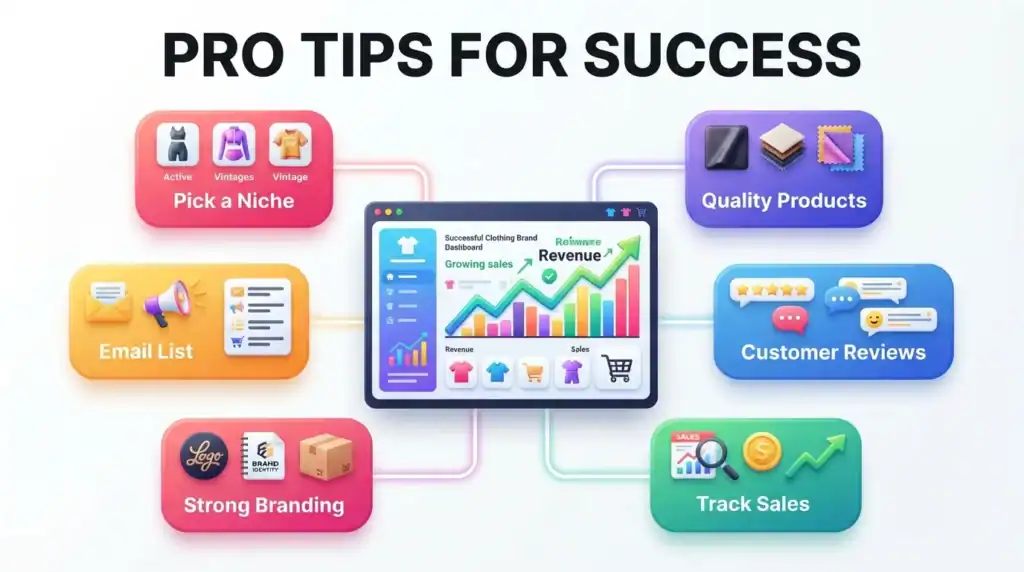
A clothing brand is more than a name and logo.
Build consistency across:
- Brand name
- Logo
- Color palette
- Typography
- Photography
- Packaging
- Brand voice
- Product presentation
- Value proposition
Your value proposition should answer:
Why should someone buy from your brand instead of another clothing store?
Possible advantages include:
- Better fit
- Unique designs
- Affordable pricing
- Premium fabrics
- Modest styles
- Inclusive sizing
- Local production
- Sustainable materials
- Faster fulfillment
- Better customer service
Make the positioning specific
Instead of:
“High-quality fashion for everyone.”
Try:
Breathable modest workwear for women who want professional outfits with everyday comfort.
The second statement gives you a clearer customer, problem, and product promise.
6. Find Reliable Clothing Suppliers
Your supplier can directly affect:
- Product quality
- Customer satisfaction
- Returns
- Reviews
- Delivery times
- Profitability
- Brand reputation
When comparing suppliers, consider:
- Product quality
- Fabric composition
- Size accuracy
- Minimum order quantity
- Sample availability
- Production time
- Shipping options
- Private-label services
- Packaging
- Replacement policies
- Communication
Always Order Samples
Before committing to a large order, inspect samples carefully.
Check:
- Stitching
- Fabric weight
- Fabric composition
- Measurements
- Zippers
- Buttons
- Printing
- Embroidery
- Labels
- Color consistency
- Shrinkage
- Overall finishing
If you are developing custom clothing, provide detailed specifications so the manufacturer understands your requirements.
7. Calculate Your Clothing Business Startup Costs
There is no universal amount required to start an online clothing business. If you’re working with a limited budget, see our guide to starting a small business from home.
Your investment depends on:
- Business model
- Product range
- Inventory
- Samples
- Website
- Packaging
- Photography
- Shipping
- Marketing
- Registration
- Payment processing
- Software
The SBA provides business-planning resources covering startup costs, business planning, funding, and other considerations entrepreneurs should evaluate before launching.
Common Startup Expenses
| Expense | Purpose |
| Product samples | Test quality and fit |
| Inventory | Stock products |
| Website/domain | Sell products online |
| Packaging | Protect and present orders |
| Photography | Show products clearly |
| Shipping | Deliver orders |
| Registration | Establish the business where required |
| Payment processing | Accept payments |
| Marketing | Generate demand |
| Software | Manage operations |
8. Price Your Clothing for Profit
Revenue is not the same as profit.
Start with your landed cost:
Product cost + shipping + packaging + applicable duties/taxes = landed cost
Then consider additional costs such as:
- Payment processing
- Advertising
- Discounts
- Returns
- Platform fees
- Customer service
- Software
- Storage
- Fulfillment
- Overhead
Example
Suppose:
- Product cost = $10
- Shipping = $3
- Packaging = $2
Your landed cost is:
$10 + $3 + $2 = $15
If you sell the product for $30, you have $15 and other costs such as payment fees, advertising, returns, software, and overhead.
So a $30 selling price does not automatically mean $15 profit.
Track Unit Economics
A useful basic calculation is:
Contribution per order = Selling price − variable costs
Your variable costs may include:
- Product
- Packaging
- Shipping subsidy
- Payment fees
- Marketplace fees
- Expected return costs
- Customer acquisition
Your pricing should ensure that you sufficiently cover your costs, gain new clients, and still make a profit.
9. Develop Your Online Clothing Store
Your website should be designed in a way that it facilitates information search about the offered products and encourages visitors to make a purchase.
Every important product page should include:
- Clear product title
- High-quality images
- Price
- Available sizes
- Color options
- Size chart
- Material information
- Product description
- Shipping information
- Return policy
- Reviews, when available
- Clear add-to-cart button
Make Mobile a Priority
Test the complete customer journey on a phone:
Product page → size selection → cart → checkout → payment → confirmation
Look for:
- Slow-loading images
- Tiny text
- Difficult menus
- Broken buttons
- Confusing size information
- Unexpected checkout steps
SEO Basics
Use relevant search terms naturally in:
- Page titles
- Main headings
- Product names
- Product descriptions
- Category pages
- Image alt text
- Internal links
Do not stuff keywords.
Google’s guidance stresses content created to be genuinely useful to humans, informative, valuable, and rewarding to the end-user rather than content designed to manipulate the search engine into generating traffic.
10. Use product photography that instills confidence
Because your client can’t actually touch your clothes, they need to see what they’re buying.
Your images should therefore communicate as much useful information as possible.
Show:
- Front view
- Back view
- Side view
- Clothing worn by a model
- Fabric close-ups
- Different colors
- Fit
- Length
- Important details
- Lifestyle context
Short videos can also demonstrate:
- Movement
- Fabric texture
- Fit
- Stretch
- Styling
- Product details
Keep your photography consistent so your store looks like one brand rather than a collection of unrelated products.
11. Set Up Shipping and Returns Before Launch
Before accepting orders, decide exactly how fulfillment and returns will work.
Clearly explain:
- Where you deliver
- Shipping charges
- Estimated delivery times
- Tracking
- Return conditions
- Exchange rules
- Refund process
- Who pays return shipping
- What happens with damaged or incorrect orders
If you sell internationally, research the customs, taxes, labeling, shipping, and consumer-protection requirements applicable to each target market.
Be Accurate About Delivery Times
Do not promise a delivery date that you can’t deliver on time.
For instance, in the United States, according to the FTC’s Mail, Internet, or Telephone Order Merchandise Rule, a seller must have a reasonable basis for any representations about shipping. If the seller is unable to deliver the package within the promised time frame, the rules concern mandatory shipping updates, customer approval of an alternate timeline, cancellations, and refunds.
Depending on the country, the rules about sales, deliveries, and returns may be different. That is why companies should research the regulations in their operational country or region.
12. Launch Your Clothing Brand
Marketing can begin before your store officially opens. You can also explore these work-from-home business ideas .
Potential channels include:
- TikTok
- Email marketing
- Influencer partnerships
- User-generated content
- SEO
- Paid advertising
- Creator partnerships
- Referral marketing
Do not rely exclusively on product photos.
More: Free Business Name Generator
Create content around:
- Outfit ideas
- Styling tips
- Behind-the-scenes production
- Fabric details
- Product demonstrations
- Customer reviews
- Different ways to wear products
- Founder stories
- Common customer questions
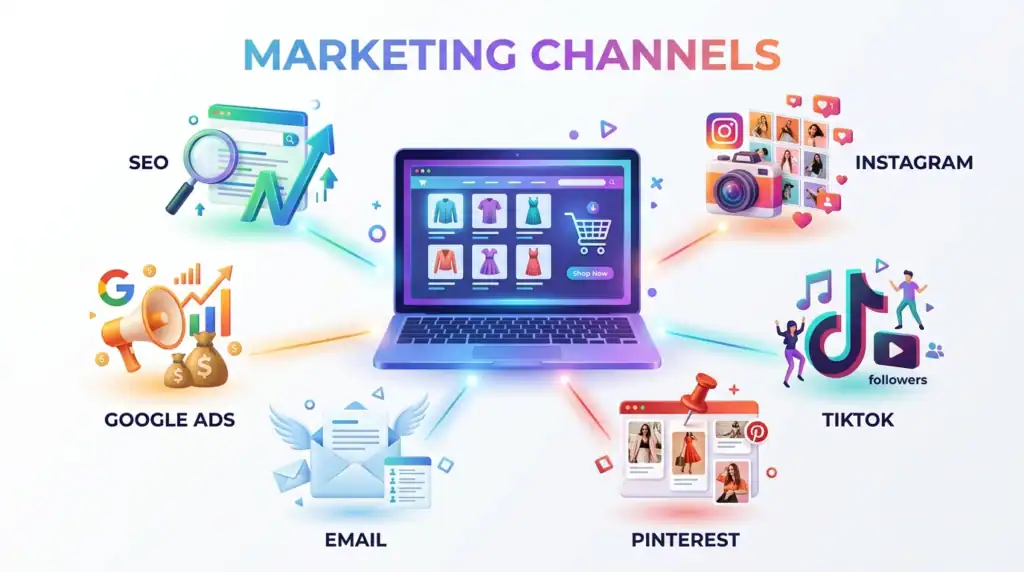
Choose Channels Strategically
- Do not try to show up everywhere. Focus on the channels that your customer is visiting.
- A concentrated marketing effort will yield better results than spreading efforts too thin to be everywhere.
- A focused marketing effort is more likely to produce quantifiable results that can be measured against a standard set of criteria than an effort that is unfocused.
13. Get Your First 100 Customers
Your first customers provide more than revenue.
They provide information.
A practical approach is to:
- Build a small audience before launch.
- Collect email addresses from interested visitors.
- Work with relevant creators.
- Publish useful content consistently.
- Give early shoppers a clear reason to try the brand.
- Request reviews from satisfied customers.
- Encourage authentic user-generated content.
- Track which products and channels generate sales.
Do not measure marketing success by followers or likes alone.
Track:
- Website traffic
- Conversion rate
- Revenue
- Customer acquisition cost
- Average order value
- Contribution margin
- Repeat purchases
The goal is not simply to build the biggest audience.
It is to build an audience that can become profitable customers.
14. Track the Numbers That Matter
Once orders begin, monitor your performance regularly.
Conversion Rate
Orders ÷ website sessions × 100
This shows how effectively your store turns visitors into buyers.
Average Order Value
Revenue ÷ number of orders
This shows how much customers spend per transaction.
Customer Acquisition Cost
Marketing and sales costs divided by the number of new customers acquired.
This helps determine how much you are spending to acquire each customer.
Return Rate
Returned orders ÷ total orders × 100
A high return rate can indicate problems with:
- Fit
- Size information
- Product expectations
- Quality
- Photography
- Product descriptions
Product-Level Profitability
Do not only ask:
Which product sells the most?
Also ask:
Which product produces the most useful contribution after variable costs?
A product with fewer sales can sometimes be more valuable than a high-volume product with weak margins.
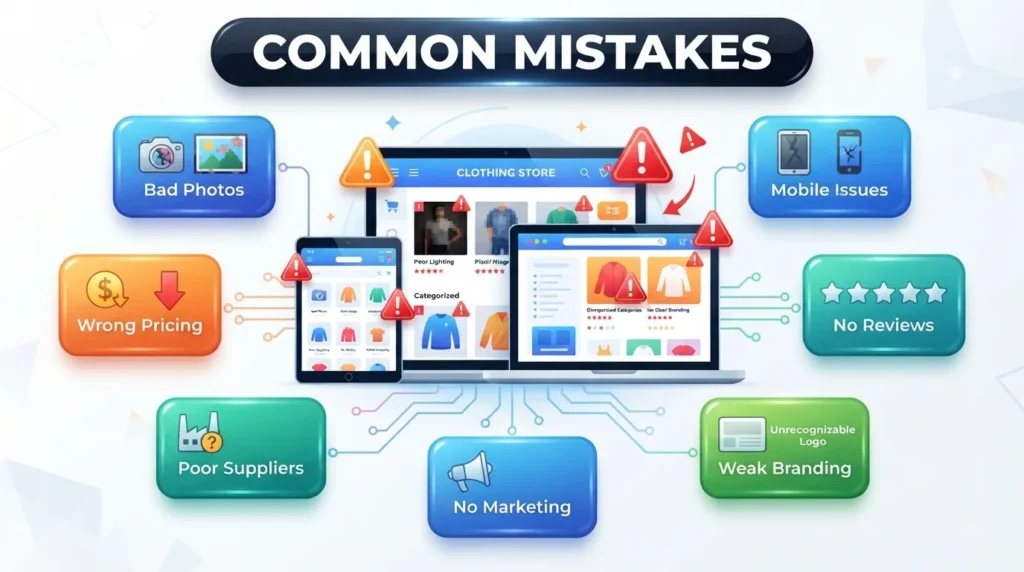
15. Avoid Common Clothing Business Mistakes
New clothing entrepreneurs often make avoidable mistakes.
Watch out for:
- Ordering too much inventory
- Choosing a niche without research
- Working with unreliable suppliers
- Skipping samples
- Ignoring sizing problems
- Underpricing products
- Running ads before testing the offer
- Using weak photography
- Hiding return information
- Launching too many products
- Trying to manage every social platform
- Measuring followers instead of business results
- Making delivery promises without confirming fulfillment capacity
The Biggest Mistake
Trying to look like a large established brand before proving that customers want the product.
A focused launch gives you more flexibility to test, learn, and improve.
30-Day Online Clothing Business Launch Plan
Week 1: Research and Planning
Goal: understand the market before spending heavily.
- Choose a specific niche.
- Define your target customer.
- Research competitors.
- Identify recurring customer complaints.
- Compare business models.
- Estimate startup costs.
- Set an initial budget.
Week 2: Products and Branding
Goal: create a focused initial offer.
- Find potential suppliers.
- Order samples.
- Test product quality.
- Choose initial products.
- Calculate landed costs.
- Set pricing.
- Create your brand identity.
- Prepare product specifications.
Week 3: Store Preparation
Goal: make the business ready to accept orders.
- Build your e-commerce website.
- Photograph products.
- Write product descriptions.
- Add size charts.
- Configure payment methods.
- Configure shipping.
- Publish return policies.
- Test checkout on mobile.
- Prepare launch content.
Week 4: Launch and Learn
Goal: get real customer feedback.
- Launch the store.
- Publish content.
- Contact relevant creators.
- Promote initial products.
- Collect customer questions.
- Request reviews.
- Monitor conversion rate.
- Track sales and costs.
- Identify your strongest products.
The first month is not about making everything perfect.
It is about getting the business in front of real customers and learning what happens next.
Conclusion
Starting an online clothing business does not require a large amount or thousands of social media followers. The only matter is choosing a clear niche, understanding your customer needs, and planning for your business growth carefully.
It’s usually better to start with a limited range of products and see which items attract the customer most. As demand grows, you can add more products and can increase your investment. Always keep an eye on sales, costs, and customer feedback so you can make better decisions as the business develops.
FAQs
Can I start a clothing business with little money?
Yes, you can start a clothing business with little money by using print-on-demand, dropshipping, or other methods instead of investing heavily in inventory.
How much does it cost to start an online clothing business?
There is no exact figure, as everything depends on the scale and specifics of your clothing business: the initial investment is determined by inventory, website-building materials, packaging, marketing, shipping, and many other factors.
Is an online clothing business profitable?
An online clothing business is profitable, but the margins depend on many factors: the price and cost of the clothes, marketing expenditures, shipping costs, returns, and numerous other expenses.
How can I find the best clothing suppliers?
You can find the best clothing suppliers by comparing manufacturers, wholesalers, private-label suppliers, and print-on-demand companies’ offers in terms of quality, pricing, MOQ, shipping conditions, and reviews.
How many clothing products should I offer at the start of my clothing business?
It is better to begin a clothing line with a small assortment to reduce the risks.
Disclaimer
The information given is for general education purposes only and should not be taken as legal, tax, accounting, or financial advice.
The requirements can be different in each country; therefore, be sure to check what the specific rules are in your country and whether you are eligible to apply or not, or contact the local tax agency or accountancy firm.