How to Validate a Business Idea Before Investing Money
Before investing your savings into a new business, it is essential to find out whether people actually want what you plan to sell. This is called business validation, and a simple validation process can help you test demand, understand customers, assess competitors, and verify that the numbers make sense.
You don’t need a larger budget to start. Talk to potential customers, study existing alternatives, create a basic version of your offer, and look for real buying signals. If the evidence is weak, change the idea before committing more money. If the evidence is strong, you can invest gradually with greater confidence.
More:Check Business Ideas with Ai
What Is Business Idea Validation?
Business idea validation is the process of testing whether a business idea has enough customer demand to be worth pursuing.
A useful validation process answers three basic questions:
- Do people have the problem you’re trying to solve?
- Do they want your proposed solution?
- Will it pay off enough that it will become a viable business?
For instance, say you want to open a home-based lunch delivery service for offices.
Rather than investing right away in commercial-grade equipment and a rental kitchen, first talk to offices about what they would be interested in having, research the competition, create a small menu, set up a few lunch orders, and determine how much you are making per order.
This allows you to test the waters and have proof of concept before you fully invest.
Why Validate a Business Idea Before Investing?
A good-looking business idea can fail for practical reasons.
Customers might not see the problem as important enough to pay for. Competitors may already offer a better solution. Your selling price may not leave enough profit after expenses. You may also discover that reaching your target customers costs more than expected.
Validation helps uncover these problems early.
More: Top 10 Profitable Small Business Ideas You Can Start Today
It can help you:
- Avoid unnecessary startup expenses
- Understand what customers actually want
- Find weaknesses in your original idea
- Test different prices
- Identify better customer segments
- Estimate potential profit
- Improve your offer before launch
- Decide whether to continue, change, or abandon the idea
The purpose isn’t to eliminate risk. No business can guarantee that. The purpose is to replace as much guesswork as possible with evidence.
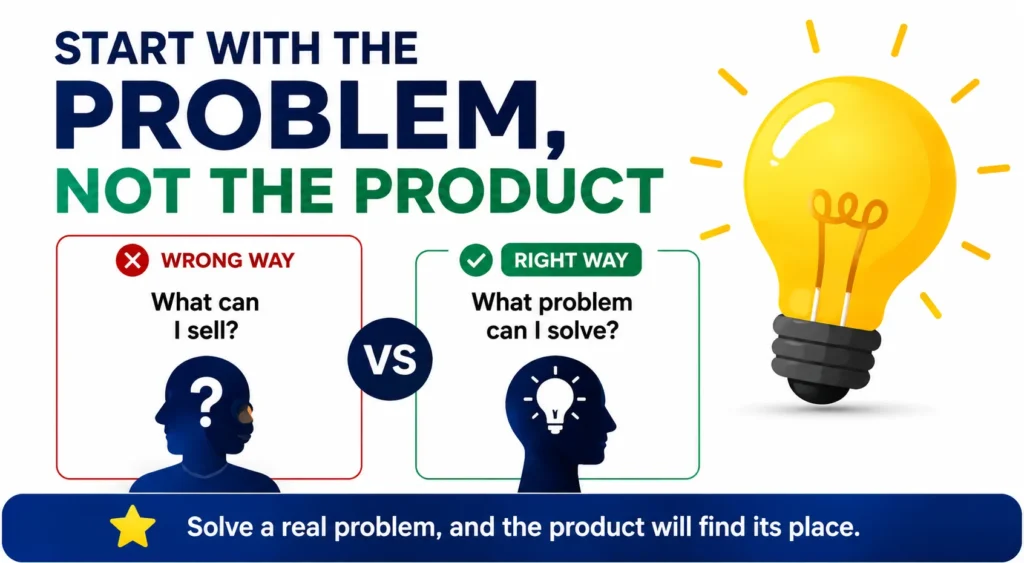
1. Focus on the Problem First, Not the Product
Begin by asking, “What problem can I help people solve? ” instead of “What can I sell?”
Ask:
“What problem am I solving, and who experiences it?”
A product is easier to sell when it solves a problem that customers already recognize.
For example:
Weak idea:
“I want to sell reusable water bottles.”
Stronger business problem:
“People at local gyms need water bottles that won’t leak and are easy to carry in a gym bag.”
The second version gives you something specific to investigate.
Ask potential customers:
- How do you handle this problem now?
- How often does it happen?
- What problems do you have with the current solution?
- How much do you currently spend?
- What would make you switch to another option?
Their answers can reveal whether the problem is real or simply something you assumed people cared about.
2. Define Your Target Customer
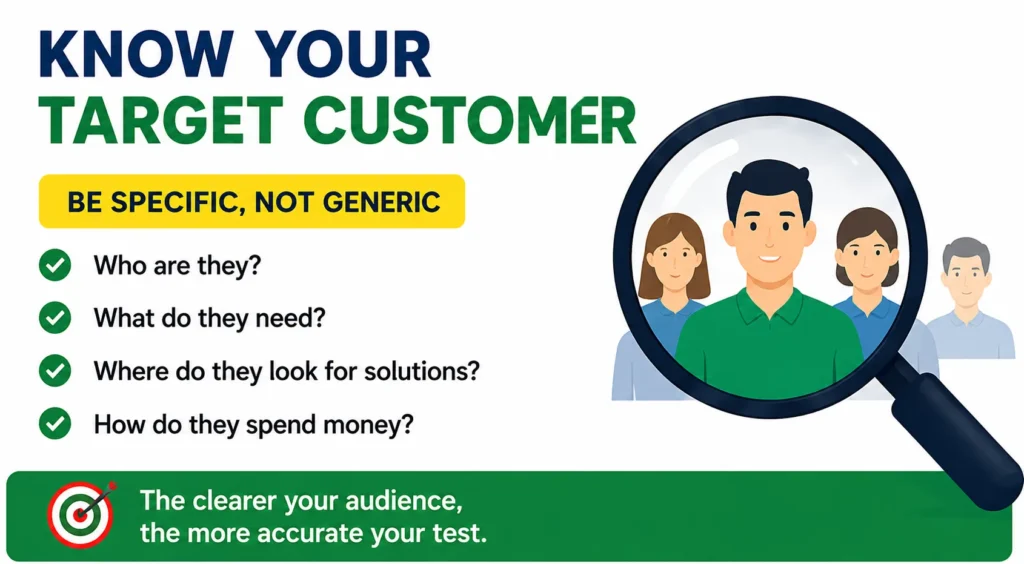
Avoid validating an idea with a target market as broad as “everyone.”
Choose a specific group first.
For example:
- University students looking for affordable meals
- Small businesses needing social media services
- Parents looking for after-school tutoring
- Local offices needing regular lunch delivery
- Homeowners searching for basic maintenance services
Then identify what this group needs, where they look for solutions, and how they currently spend money.
A specific audience also makes your testing more reliable. If you ask random people for opinions, their answers may have little connection to your actual market.
More: 25 Best Online Business Ideas for Students Without Investment
3. Research Your Competitors
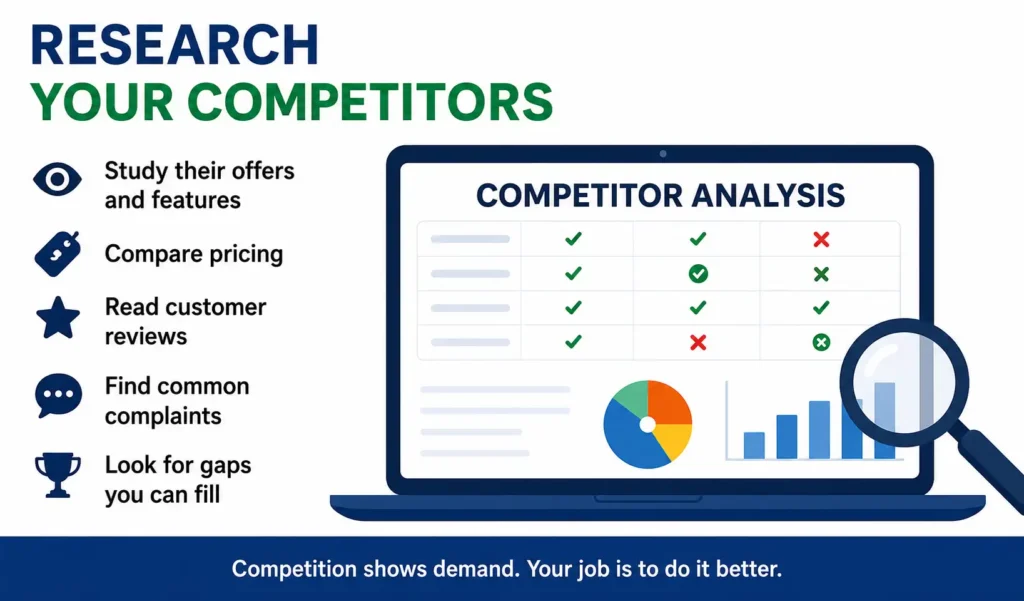
Search for businesses already offering something similar.
Competition isn’t automatically a warning sign. It can actually provide evidence that customers already spend money in the market.
Study:
- Product or service range
- Prices
- Customer reviews
- Delivery or service areas
- Website experience
- Social media activity
- Promotions
- Common complaints
- Features customers praise
Customer reviews are particularly useful.
If several customers complain that competitors take too long to deliver, for example, faster delivery could become part of your value proposition.
Don’t copy the competitor. Use the research to understand what customers already have and where there may be room for a better offer.
4. Talk to Potential Customers
Talking to potential customers is one of the easiest and cheapest ways to test a business idea.
Find people who actually match your target customer profile and ask about their current behavior.
Avoid questions that encourage polite answers.
Instead of:
“Would you buy this?”
Ask:
- “What do you currently use?”
- “How much do you normally pay?”
- “What annoys you about that option?”
- “When did you last have this problem?”
- “What made you choose your current provider?”
- “What would make you try another option?”
Someone saying “That’s a good idea” is very different from someone asking, “How much does it cost, and when can I get it?”
The second response provides much stronger evidence.
5. Create a Simple Test Version
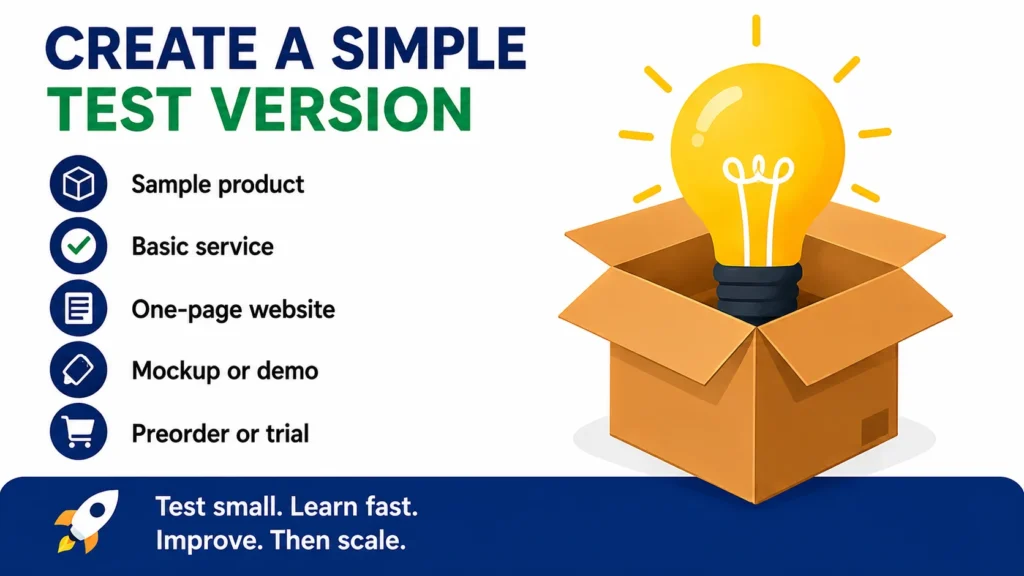
You don’t always need the finished product to validate the idea.
Create the smallest realistic version that allows customers to experience the offer.
Depending on the business, this could be:
- A sample product
- A basic service package
- A one-page website
- A simple menu
- A product mockup
- A free demonstration
- A limited trial
- A preorder
- A small batch of inventory
Let’s say you have an idea for a custom t-shirt business.
More: How to Start an Online Clothing Business From Home
You don’t need to go out and buy 500 t-shirts right away. Just make a few samples, sell them to your target market, and get recurring orders. This is sometimes called a minimum viable product–the most basic version of something that can be used to test business ideas.
6. Test Whether Customers Will Actually Pay
Interest isn’t enough.
People can like your idea without ever buying it.
Look for stronger signals such as:
- Price enquiries
- Product requests
- Trial bookings
- Preorders
- Deposits
- Paid consultations
- Small purchases
- Repeat orders
- Referrals from existing customers
You don’t necessarily need a large number of sales at this stage. You need enough real behavior to learn whether your assumption has merit.
If nobody is willing to take the next step after seeing your offer, don’t immediately spend more money. First investigate why.
The problem could be the product, price, message, target audience, or simply the way you’re presenting the offer.
7. Test Your Pricing Before You Invest
A business can have strong demand and still be unprofitable.
Suppose you plan to sell a service for $50.
Your direct cost per sale is $20, leaving:
$50 − $20 = $30 gross profit
But that $30 isn’t necessarily your final profit. You may still have advertising, software, staff, rent, payment fees, taxes, and other operating costs.
Before investing, estimate:
- Selling price
- Direct cost per sale
- Gross profit per sale
- Monthly fixed expenses
- Expected number of customers
- Customer acquisition cost
- Break-even point
Also test whether customers accept your proposed price.
If customers only want to pay $30 while your costs require a $50 price, you have a business model problem that should be solved before launch.
8. Calculate Your Break-Even Point
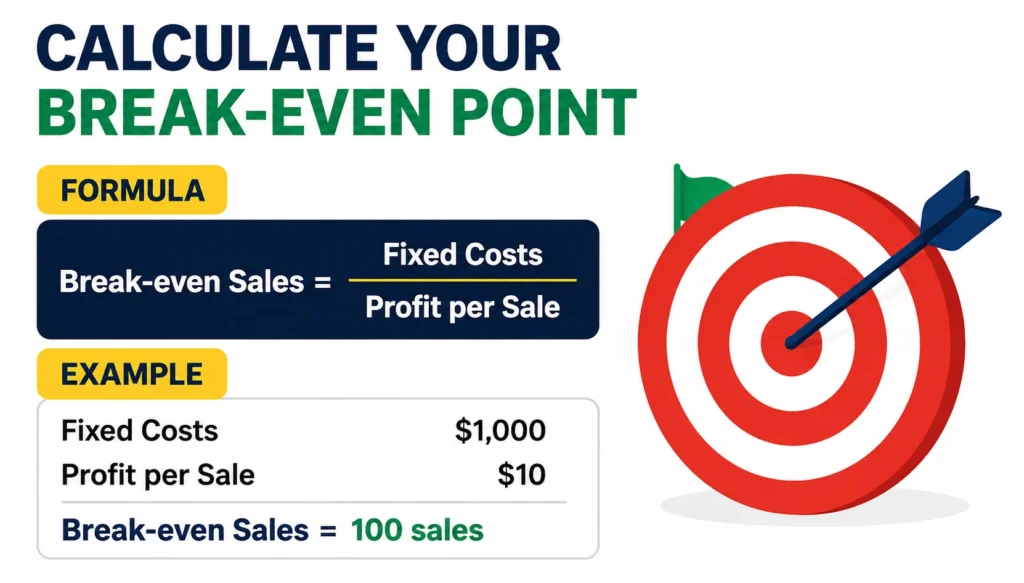
Break-even tells you how much sales are needed to cover your costs over a certain period of time, after which you start making a profit.
The formula: Break-even sales = Fixed costs / (Profit per Sale )
Example:
Suppose you have a flat cost of $1,000 and you make $10 from one sale:
$1,000 ÷ $10 = 100 sales
So, that means that there should be at least 100 sales per month to cover your costs. If this number is too high for you, you should reconsider selling prices or costs and your entire strategy before launch.
9. Estimate Startup Costs in Two Categories
List every expense you expect to face.
One-time costs
Examples include:
- Equipment
- Initial inventory
- Website setup
- Branding
- Furniture
- Licenses
- Tools
Recurring costs
Examples include:
- Rent
- Software subscriptions
- Internet
- Advertising
- Staff
- Packaging
- Delivery
- Utilities
Then mark each expense as either:
Required for testing or can wait until later.
This can help you avoid wasting money on the wrong idea.
You might discover that you can test the idea with $100–$300 rather than spending thousands before your first customer.
10. Run a Small Real-World Test
Once you’ve tested the problem, audience, offer, and price, run a controlled market test.
Set a small budget and a specific target.
For example:
“I’ll test this service with 20 potential customers and aim to get my first five paid customers.”
Track the results.
| Metric | What It Tells You |
| Enquiries | Initial interest |
| Quotes requested | Buying consideration |
| Sales | Actual demand |
| Cost per customer | Acquisition efficiency |
| Revenue | Money generated |
| Profit per sale | Unit economics |
| Repeat orders | Customer satisfaction and retention |
| Feedback | What needs improvement |
Don’t judge the entire business from one test. Treat the result as information.
If customers show interest but don’t buy, investigate the reason rather than simply increasing your budget.
11. Use a Green, Yellow, or Red Decision
After testing, classify what you found.
🟢 Green: Move Forward
You have evidence that:
- Customers have a real problem.
- People understand your offer.
- Some customers are willing to pay.
- Your pricing can leave room for profit.
- You have a realistic way to reach more customers.
You can increase your investment gradually.
🟡 Yellow: Improve and Retest
You see interest, but something is unclear.
For example:
- Customers like the product but reject the price.
- People want the service but prefer a different package.
- Demand exists in one customer group but not another.
- Your costs are higher than expected.
Don’t abandon the idea immediately. Change one major variable and test again.
🔴 Red: Stop or Rethink
Warning signs include:
- Target customers don’t recognize the problem.
- Nobody shows meaningful buying intent.
- Customers won’t pay a workable price.
- The market is too difficult to reach.
- Costs make the model unattractive.
Stopping an idea at this stage isn’t necessarily failure. It can prevent a much bigger financial mistake.
Mistakes to Avoid When Validating a Business Idea
Relying only on friends and family
They may support you personally without becoming paying customers.
Buying too much inventory
Start with a small batch whenever the business model allows it.
Treating social media likes as sales.
Attention can be useful, but money changing hands is a much stronger signal.
Asking leading questions
“Wouldn’t you love an affordable version of this?” encourages a positive answer. Ask about existing behavior instead.
Changing everything at once
If you change the audience, price, product, and marketing message together, you won’t know what caused the result.
Ignoring negative feedback
Negative feedback can be more valuable than praise because it shows what may prevent a purchase.
Assuming competition means failure
Competitors can demonstrate existing demand. The real question is whether you have a realistic way to compete.
How Long Should You Validate a Business Idea?
There is no fixed validation period.
A simple service may be tested within days or weeks. A product requiring manufacturing, licensing, or significant development may require much longer.
Focus on reaching useful evidence rather than waiting for a specific number of days.
Your test should answer the major questions:
- Is there a real customer problem?
- Who has it?
- What solution do they currently use?
- Will they consider your offer?
- Will they pay your target price?
- Can you serve them profitably?
Once you have reasonable evidence, move forward in stages rather than making one large investment.
What to Do After Validating Your Business Idea
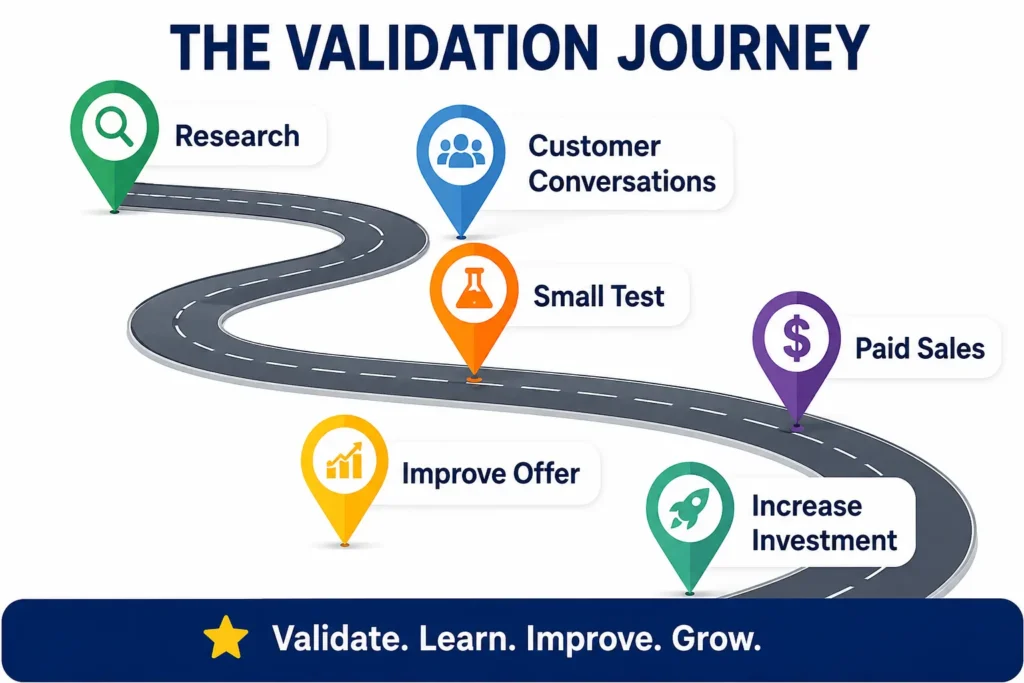
If the results are positive, instead of trying to invest all your resources at once, try to increase your commitment to the business idea gradually. One possible way is
Research → Customer conversations → Small test → Paid sales → Improve offer → Increase the investment.
Apply what you have learned at one step to the next. If the tests are not promising, return to the stage that checked the faulty assumption, nd try to alter it. You might need to change your customer, offering, pricing, marketing channel, or the problem your product will solve.
The most compelling business model is not necessarily the most compelling one. Instead, it often turns out that the most realistic business concept is the one that has been tested against real customers’ concerns and, therefore, has financial potential.
More: Ai Business Adviser
FAQs
How do I validate a business idea before spending money?
I can start by consulting with potential customers if they need what I offer, checking out my competitors, testing the offer, and seeing if I can get someone to buy before going further.
How do I validate a business idea cheaply?
I can ask potential customers, research my competitors, announce the offer online, or take some pre-orders. These are the best and cheapest options to test my business idea.
How many customers do I need to validate a business idea?
It doesn’t mean I need a hundred customers. It should be enough if I get a few interested people who will be willing to pay for my offer. This way, I can already see if my idea works with the right target audience.
Do I need to build my product before validating my business idea?
I shouldn’t do that; instead, I should test my product first with some people before investing in producing more items. When my initial product gets positive feedback from customers, I can then continue developing and improving my chosen niche.
How could I know if my business idea is viable?
I can calculate my projected selling price against my costs. With these two figures, I can determine how much I need to sell to become profitable.
People seem to like my business idea, but they are not paying for it. Why?
I need to understand why my idea is not turning into paying customers. Maybe my projected selling price is far from what my target audience expects to pay. My product offering, target market, value proposition, and pricing strategy must be re-evaluated before I continue investing in the concept.